

Learn more about this product!
Sale on until June 30th
Available Now!
Applications Open!
Register an account with RME to store your favorite equipment and easily compare between units.
RegisterLearn more about this product!
Sale on until June 30th
Available Now!
Applications Open!
WHAT IS GPS?
The GPS (Global Positioning System) operated by the U.S department of Defence and GLONASS operated by the Russian Federation are a space-based navigation system formed from a network of satellites which determine the position of a vehicle using signals from the 32 satellites that circle the earth. These satellites travel in known orbits that allow a land based receiver to determine its own position in relation to each satellite from which it receives a signal.
The signals generated by GPS alone are not accurate enough for use in agriculture. Therefore, corrections must be made to GPS signals to improve their accuracy. With these correction signals we refer to the system as DGPS
(Differential Global Positioning System).
There are two main DGPS correction services available today:
SBAS
The GPS (Global Positioning System) operated by the U.S department of Defence and GLONASS operated by the SBAS-Satellite Based Augmentation System,communicate difference via geostationary satellite.
RTK
Real Time Kinematics, communicate difference directly to the vehicle via short wave radio from a local base station.
HOW ACCURATE IS GPS?
An uncorrected GPS or GLONASS signal gives you position accuracy between 5 to 10 meters. This is more than adequate for car navigation systems, but not accurate enough for vehicle guidance in agricultural applications, where we need Pass-to-Pass and Year-to-Year accuracy and repeatability.
Pass-to-Pass accuracy measures the relative accuracy over a 15 minute interval. This is usually thought of as skip/overlap from one pass to the next when driving swaths. A New Holland receiver with pass-to-pass accuracy of
+/-2.5 cm means you get less than +/-2.5 cm skip or overlap, 95% of the time.
Year-to-Year accuracy is the measure of repeatable accuracy which means that you can drive the same rows a day, week, month, or year later. So, +/- 2.5 cm year-to-year accuracy means you can drive the same rows next year within
+/- 2.5 cm of this year’s rows, 95% of the time.
GIVE YOUR BUSINESS A COMPLETE AND FLEXIBLE GPS SOLUTION
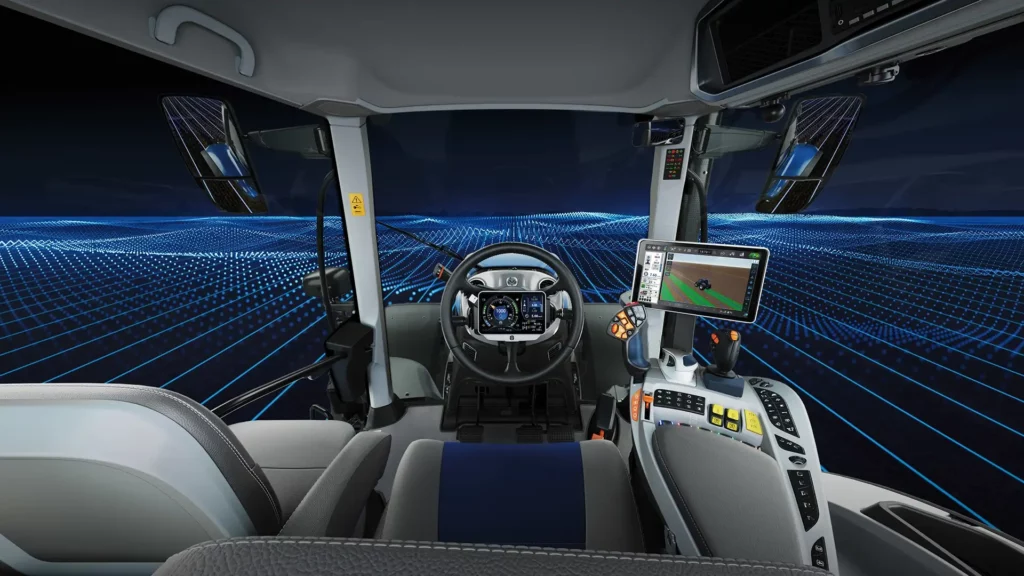
From the enhanced productivity of lightbar guidance, to the pinpoint accuracy of fully integrated guidance, and the valuable analysis of yield data, our Precision Land Management offering will help maximise yields, control input costs and optimise profits.
REDUCE OPERATIONAL COSTS
The primary purpose of New Holland’s Precision Land Management is to save fuel and input costs by ensuring parallel passes when working either in straight lines, curves, pivots or on undulating ground minimising skips and overlaps.
IMPROVE PRODUCTIVITY, EVEN IN DUSTY CONDITIONS When planting, spraying, cultivating or harvesting in difficult weather conditions or at night, the operator can focus on his task without any risk of overlap or joining rows while driving faster.
CONTROLLED TRAFFIC FARMING PRACTICES
With RTK enabled New Holland guidance systems the practice of Controlled Traffic Farming can be adopted, leading to a significant reduction in field compaction improving overall yields
POWER WITH PURPOSE Why settle for anything less than a Steiger? Good thing you don’t have to. With 778 peak horsepower, a heavy-duty Quadtrac undercarriage and nimble, maneuverable handling you’ve come to expect from Steiger series tractors, the all-new Steiger 715 tractor won’t have you settling for less—you’ll be settling for the best. https://www.youtube.com/watch?v=yHYrcYkm1cE Strengthen… Read More
___________________________________________________________________________________________________________________ The Greatest Outdoor Show on Earth has had its share of ups and downs over the years as it evolved into what we know it to be today. From 1886 when the Calgary and District Agricultural Society held its first fair, to 1912 when American promoter Guy Weadick organized the Frontier Days Celebration and… Read More
New technology can remove the guesswork from operating equipment and help drive management decisions, so it’s important to know which options are best for your operation. Consider incorporating these productivity-enhancing tech solutions. Automation From harvest to tillage, automation brings a new level of simplicity to any operation by helping decrease operator fatigue and reduce errors…. Read More
By signing up, you agree to receive emails. Unsubscribe at any time by clicking on the unsubscribe link at the bottom of our emails. Contact us for questions.